21 models on Yuchai, SDEC and Weichai/Wuxi engines — with the fuel burn, the dimensions and the container loading figures you actually need to shortlist one
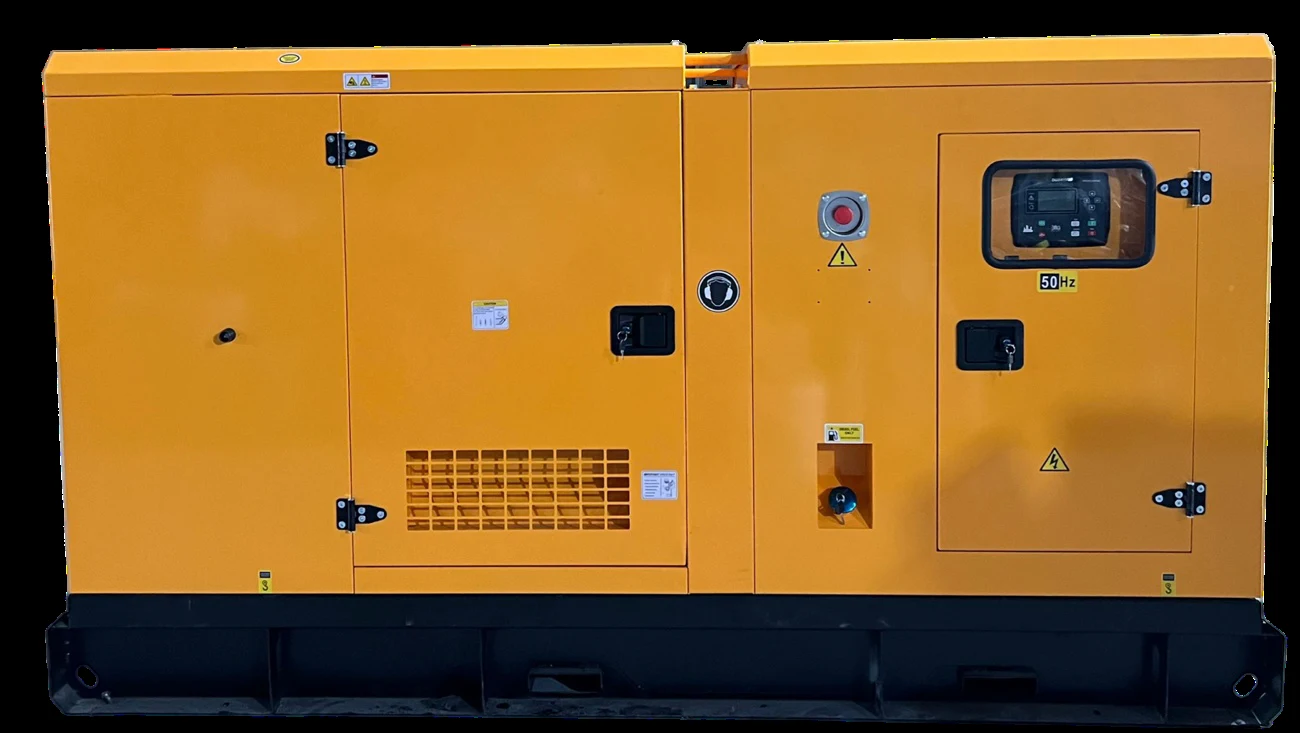
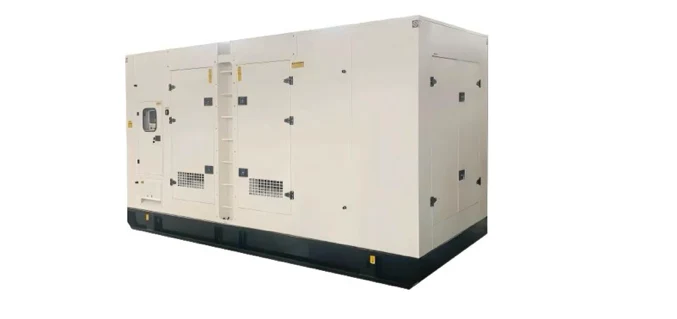
Photographed at our generator partner plant — canopy sets in the 250–1,000 kVA band.
A 20 kVA set is bought on price. A 500 kVA set is bought on what it will cost you to run for the next ten years. That is the shift that happens somewhere around 250 kVA — mining camps, factories, hospitals, cold rooms and construction sites all live in this band, and the three questions that decide the purchase stop being about the name on the radiator. They are: how many litres an hour at the load I actually run, whether it will fit through my gate and into my container, and how many I can land in one shipment. Everything below is our working list for that band — real model numbers, real dimensions, at power factor 0.8.
| Class | Engine make | Genset model | Engine model | Prime kW | ≈ kVA | L/h @75% | L/h @100% | L × W × H mm | Weight kg | Per 40′ HQ |
|---|---|---|---|---|---|---|---|---|---|---|
| 250 kVA | Yuchai | KTZ180YC | YC6A275-D30 | 185 | 231 | 35.5 | 47.4 | 3050 × 1150 × 1800 | 2300 | 3 |
| 250 kVA | SDEC (Shangchai) | KTZ200SC | SC8D280D2 | 206 | 258 | 36.8 | 49.0 | 2600 × 1150 × 1800 | 2500 | 4 |
| 300 kVA | Yuchai | KTZ220YC | YC6MK350L-D20 | 235 | 294 | 40.9 | 54.6 | 3050 × 1150 × 1800 | 2400 | 3 |
| 300 kVA | SDEC (Shangchai) | KTZ250SC | SC9D340D2 | 250 | 312 | 44.6 | 59.5 | 2900 × 1150 × 1800 | 3500 | 4 |
| 300 kVA | Weichai / Wuxi | KTZ230WD | WD129TAD23 | 259 | 324 | 45.8 | 61.0 | 2750 × 1200 × 1800 | 2400 | 4 |
| 350 kVA | Yuchai | KTZ250YC | YC6MK420L-D20 | 281 | 351 | 48.9 | 65.2 | 3050 × 1150 × 1800 | 2450 | 3 |
| 350 kVA | SDEC (Shangchai) | KTZ250SC | SC9D340D2 | 250 | 312 | 44.6 | 59.5 | 2900 × 1150 × 1800 | 3500 | 4 |
| 350 kVA | Weichai / Wuxi | KTZ250WD | WD129TAD25 | 284 | 355 | 50.2 | 66.9 | 2800 × 1200 × 1800 | 2550 | 4 |
| 400 kVA | Yuchai | KTZ300YC | YC6MJ480L-D20 | 321 | 401 | 55.9 | 74.5 | 3050 × 1150 × 1800 | 2500 | 3 |
| 400 kVA | SDEC (Shangchai) | KTZ300SC | SC12E460D2 | 338 | 422 | 59.8 | 79.7 | 3050 × 1250 × 1850 | 3700 | 3 |
| 400 kVA | Weichai / Wuxi | KTZ280WD | WD135TAD28 | 308 | 385 | 54.5 | 72.6 | 2900 × 1200 × 1800 | 2600 | 4 |
| 500 kVA | Yuchai | KTZ400YC | YC6K570-D30 | 389 | 486 | 68.8 | 91.7 | 3200 × 1200 × 2000 | 3750 | 3 |
| 500 kVA | SDEC (Shangchai) | KTZ400SC | SC25G610D2 | 446 | 558 | 81.6 | 108.8 | 3200 × 1200 × 2000 | 3750 | 3 |
| 500 kVA | Weichai / Wuxi | KTZ350WD | WD145TAD35 | 388 | 485 | 68.6 | 91.5 | 3100 × 1200 × 1800 | 2700 | 3 |
| 600 kVA | Yuchai | KTZ440YC | YC6T660-D30/D31 | 441 | 551 | 75.6 | 100.8 | 3200 × 1200 × 2000 | 3750 | 3 |
| 600 kVA | SDEC (Shangchai) | KTZ450SC | SC25G690D2 | 505 | 631 | 92.4 | 123.2 | 3200 × 1200 × 2000 | 3750 | 3 |
| 600 kVA | Weichai / Wuxi | KTZ430WD | WD269TAD43 | 475 | 594 | 84.0 | 112.0 | 3400 × 1400 × 2000 | 3800 | 3 |
| 800 kVA | Yuchai | KTZ550YC | YC6TD840-D30/D31 | 561 | 701 | 112.7 | 150.3 | 3500 × 1250 × 2100 | 4500 | 3 |
| 800 kVA | SDEC (Shangchai) | KTZ600SC | SC27G830D2 | 610 | 762 | 111.7 | 148.9 | 3600 × 1300 × 2300 | 4600 | 3 |
| 800 kVA | Weichai / Wuxi | KTZ580WD | WD287TAD58 | 646 | 808 | 114.2 | 152.3 | 3450 × 1450 × 2100 | 4050 | 3 |
| 1000 kVA | Weichai / Wuxi | KTZ680WD | WX287TAD68 | 750 | 938 | 131.2 | 175.0 | 3450 × 1450 × 2100 | 5500 | 3 |
Prime rating at power factor 0.8, 50 Hz, 400/230 V; standby ratings available on request. Dimensions and weight refer to the sound-attenuated canopy version — open skid sets are smaller and lighter. Fuel consumption in litres of diesel per hour. Above 1,000 kVA we quote per project.
| Your site | Rating usually specified | What drives it |
|---|---|---|
| Mining camp, crusher and dewatering pumps | 400–600 kVA | Motor starting surges, 24-hour duty, dust |
| Factory running off-grid | 500–1,000 kVA | Whole-process load, often two sets in parallel |
| Hospital, hotel, office standby | 250–500 kVA | Must start within seconds; ATS essential |
| Cold room, data room, telecom | 400–800 kVA | Load cannot drop; N+1 redundancy recommended |
| Large farm — irrigation plus curing barns | 250–400 kVA | Seasonal peak, pump motors starting together |
| Construction site, moving camp | 250–500 kVA | Trailer-mounted, relocates with the job |
These are starting points, not rules. Send us your equipment list — what runs, what starts at the same time, for how many hours — and we will size the set and tell you if the rating you had in mind is too small.
Fuel is the line item that outlives the purchase price by a wide margin, and it is the number most quotations quietly leave out. Below, at 75% load — because almost no site runs a set flat out all day, and a full-load figure is a sales number, not an operating one.
| Class | Model | Engine | L/h @75% | L/h @100% | Litres per 24h @75% |
|---|---|---|---|---|---|
| 250 kVA | Yuchai | KTZ180YC | 35.5 | 47.4 | 852 L |
| 400 kVA | Yuchai | KTZ300YC | 55.9 | 74.5 | 1,342 L |
| 500 kVA | Yuchai | KTZ400YC | 68.8 | 91.7 | 1,651 L |
| 500 kVA | SDEC | KTZ400SC | 81.6 | 108.8 | 1,958 L |
| 800 kVA | Weichai / Wuxi | KTZ580WD | 114.2 | 152.3 | 2,741 L |
| 1,000 kVA | Weichai / Wuxi | KTZ680WD | 131.2 | 175.0 | 3,149 L |
Note the 500 kVA row: the Yuchai burns 68.8 litres an hour at 75% load, the SDEC 81.6 — nearly thirteen litres an hour apart on the same rating. Over a year of continuous running that gap is thousands of litres, and it is invisible if you only compare prices. This is why we send the fuel column with the quotation rather than after it.
Every set in this band fits a standard 40 ft high-cube — no open-top, no flat-rack, no heavy-lift surcharge. The tallest canopy in the range is 2,300 mm against a door aperture of about 2,580 mm, so height is never the constraint. Three sets per container is the norm; several shorter-bodied models in the 250–400 kVA band load four. Weights run from about 2.3 tonnes at 250 kVA to 5.5 tonnes at 1,000 kVA, so check your destination's crane capacity before you order.
Generator sets can also share a container with farm machinery, water pumps or spare parts from our other lines — that is often the cheapest freight you will ever book, because the generator pays for the container and everything else rides along.
All 21 sets on one A4 page, three engine makes side by side at each rating, with fuel burn and container loading — the sheet our own team works from.
Yuchai, SDEC and Weichai/Wuxi at each rating, with dimensions, weight, fuel burn and container loading. No form to fill in.
PDF · 1.4 MBLooking for the smaller band, or a different engine? See the full diesel generator range 50–3,000 kVA, or the individual sheets: Yuchai 40–560 kW, SDEC 68–610 kW, Weichai / Wuxi 259–900 kW.
Tell us what has to run, for how many hours a day, and your local voltage and frequency. We come back with the right model, the fuel figure for your load, and an exact price — usually within one working day. Single sets welcome.
Buyers in Russia, Uzbekistan and Kazakhstan — message us on Telegram @leon_dingheng.
At 75% load — the figure that matters, because almost no site runs flat out all day — a 500 kVA Yuchai set burns about 69 litres an hour, roughly 1,650 litres over a 24-hour day. At full load it is about 92 litres an hour. The SDEC 500 kVA is thirstier at around 82 litres an hour, the Weichai/Wuxi about 69. That spread of more than ten litres an hour between engine makes at the same rating is why the fuel column is worth reading before the price column.
No. At the standard power factor of 0.8, kVA = kW ÷ 0.8, so a 500 kVA set is a 400 kW set. Our models are named and rated in kW; the kVA figure is derived at 0.8 for reference. If another supplier quotes you a "500", ask which unit they mean — a 500 kW machine is substantially bigger and more expensive than a 500 kVA one.
Three, as a rule. Every set in the 250–1,000 kVA band fits a standard 40 ft high-cube without an open-top or flat-rack, because the tallest canopy is 2,300 mm against a door aperture of about 2,580 mm. Some shorter-bodied models in the 250–400 kVA band — particularly the SDEC sets at 2,600–2,900 mm long — can load four to a container. Sets can also share a container with farm machinery, pumps or spare parts to spread the freight.
Two 500 kVA sets usually win on three counts: you keep half your power if one is down for service, each set runs closer to its efficient load when site demand is low, and you can buy the second set later as the site grows. A single 1,000 kVA set costs less per kVA and takes up less space. For anything that cannot stop — cold chain, clinics, data rooms — we would push you towards two sets with a parallel control cabinet.
Prime rating is what the set delivers continuously, hour after hour, as the only source of power. Standby is a higher figure allowed for limited hours during a mains outage. A set bought on its standby number and then run as prime power is being worked beyond its design duty and will not last. Tell us your hours per day and whether a grid connection exists at all, and we will quote the right rating — the difference is explained in more detail in our standby vs prime power guide.
Build time for this range is typically a few weeks depending on engine brand and specification, then sea freight — roughly four to six weeks to West Africa, three to five weeks to East and Southern Africa from Chinese ports, before inland haulage. We give you a real date for your set and your port when we quote, not a range copied off a website. More on what actually drives lead time in our Africa lead-time guide.
At this rating, maintenance is a fuel and uptime question more than a repair question. Oil intervals, load management and fuel care decide whether a set lasts five years or twenty.
Read our diesel generator maintenance guideWork from your load list to a rating you can defend — including motor starting.
The rating mistake that costs the most, and how to avoid it.
What actually drives the date, from build slot to inland haulage.
Where a hybrid setup pays back — and where it does not.